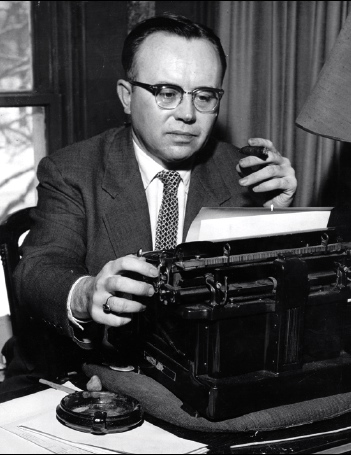
The writer Russell Kirk (1918-1994) is credited with coining the term conservatism in his 1954 book The Conservative Mind to describe thinkers in the tradition of Edmund Burke. While conservatism doesn’t have the same connotations today, Kirk’s work remains fascinating, partly because Kirk wrote and lived conservatism in a way that eschews easy labels. Biographer Bradley J. Birzer reports that Kirk saw conservatism as preserving the best of tradition, not so much about party affiliations. The fact that Kirk helped found postwar American conservatism yet often seemed an outsider in the movement—a political commentator who didn’t live in Washington, an army veteran who maintained most American wars (including the Revolutionary War) were wrong—underlines how his vision defies quick labels. He devoted his life to preserving the best of the old things because old things (methods, values, beliefs) that work offer moral and spiritual flourishing. Whether that quest fits a party agenda or translates to social acceptance is another matter.
Most discussions about how Kirk explored and practiced this quest focus on his considerable nonfiction. However, Kirk reported that his bestselling book was not any of his well-cited books on government and philosophy, but a gothic thriller. Old House of Fear, published in 1960, is an entertaining romp about a lawyer who discovers Soviet spies performing diabolical work (their leader believes he has occult powers) on a remote Scottish isle. By the time Kirk published the novel, he was already selling ghost stories to magazines. His fiction (about a dozen short stories, three total novels) was never prolific, but it won the admiration of writers like Ray Bradbury and Harlan Ellison. Often it explored similar ideas to his nonfiction under new guises.
Lord of the Hollow Dark, Kirk’s third and perhaps best novel, is particularly interesting for its treatment of historic faith. The story is a soft sequel to his story “Balgrummo’s Hell” and his novel A Creature of the Twilight: His Memorials, but it doesn’t require knowing the earlier tales. The setting is eerie from the start: a week before Ash Wednesday, a group of eccentrics (each using names from the works of T.S. Eliot as codenames) have gathered for a spiritual experience at the castle once owned by the late Lord Balgrummo. Balgrummo lived under permanent house arrest for allegedly murdering someone at a séance in 1913. The group leader, who calls himself Apollinax, has brought a former nun with her baby son to join the “festivities.” As the ceremony gets closer, Maria worries about what role she and her son will play, and that Apollinax’s ideas may not be as Christian as they sounded when she met him. She also knows that one member of the group is not at all what he seems.
Experienced readers of gothic horror find the usual ingredients (haunted castles, whispers about the previous owner, arcane literary references), but may be surprised by one addition: Kirk takes faith seriously. Frequently, especially as the 1960s ended and the American horror market shifted toward contemporary settings, God and the devil became window dressing. Rosemary’s Baby by Ira Levin may be about an expecting mother discovering her child is the antichrist, but is primarily a dark satire about New York and early feminism (Rosemary loses her agency as she becomes a mother).
Kirk wrote Lord of the Hollow Dark as someone who wanted faith to matter in his tales. He had always believed in the supernatural (his grandparents were Swedenborgian spiritualists who performed seances) and slowly moved toward Christianity. Birzer suggests that walk began sometime in the 1950s, although Kirk wasn’t received into the Roman Catholic Church until he married Annette Courtemanche in 1964. Like many Catholics, Kirk became fed up with changes caused by Vatican II, changes that inform the action in Lord of the Hollow Dark.
Maria, the young mother, is a former nun who left her order when she realized almost all of the nuns were leaving. Most of them talked little about God, more about “self-fulfillment, and how the steps of Jesus led into the world, and of helping the working classes and the poor.” Unfortunately, no one explained to Maria how to do social work well, so what could have been advice for service became glib advice about making faith relevant.
When Maria meets Apollinax, she reacts to his preaching by saying, “You’re talking about the city of God!” He seems to be capturing the heart of the faith that made her desire a vocation in the first place. As she tries to reason through what is truth and what Apollinax teaches, Maria casts her mind back to something she learned at church as a child, a time she associates with being before “the guitars” came in.
In short, Maria is a young person who has not found the attempt to blow some new air into the Catholic church’s windows has brought her closer to God. Seeking to make Christianity applicable for today only helps when leaders wisely remember some basic things must always be preserved. Without that balance, attempts to modernize everything leave people adrift.
Even Apollinax is connected to this search for relevancy. A former priest who drifted into more and more radical ideas, he has now moved so far away from Christianity’s bedrock that he has become an agent for the opposition. He is a particularly dark cult leader in a decade of many cults. As an ally explains to Maria, “When an orthodoxy decays, the old dark gods, the savage gods, win back their burnt offerings.”
Yet all is not lost. Maria finds an unlikely helper during her stay. The ally, the figure who isn’t what he appears, is an eccentric sexagenarian adventurer calling himself Manfred Arcane. Arcane is working to uncover Apollinax’s dark plans for family reasons. He is the illegitimate son of the late Lord Balgrummo, so Arcane has an interest in the family home not being misused.
Arcane at first seems not too different from Apollinax. He frankly admits he has spent most of his life as a mercenary, spy, or whatever other dangerous profession was available. The earlier novel A Creature of the Twilight opens with Arcane informing the reader that he has done evil all his life, then launches into a plot about Arcane playing Western diplomats against each other during an African coup. But as Kirk scholar Camilo Peralta notes, this novel is inspired by Evelyn Waugh’s novels Scoop and Black Mischief. As fans of Brideshead Revisited know, things are never quite what they seem in a Waugh story. In Lord of the Hollow Dark, it becomes clear that Arcane has found faith in his wanderings. Whatever he was in the past, he now fights on the side of the angels. He also has a detailed sense of the past—the castle, his father, the liturgy that Apollinax wants to invert for his dark festivities—which can help Maria and her son survive.
Lord of the Hollow Dark is therefore both a description of, and a solution to, what happens when the church favors relevancy so much it forgets tradition entirely. It describes the modern vacuum that lets men like Apollinax flourish. It also shows Arcane as offering what Apollinax lacks: knowledge of the past in all its ironies, and trust that the historic Christian tradition offers substance and direction to those who seek it.
The fact that Arcane, like Kirk himself, has a complicated spiritual pedigree underscores how the historic Christian tradition also offers mercy. If Gregory Wolfe is correct when he writes in More than Words that Scoop and Black Mischief are bleak comedies about life without God, and Collin M. Cooper is correct when he reads Brideshead Revisited as a tale about people who see faith’s grandeur but struggle to enter the fold, Lord of the Hollow Dark is a darkly ironic story about how God allows unexpected people into the kingdom and uses them for good things. God is merciful enough to let even the spotted sheep into the fold, and might even use them for rescue missions they feel unqualified for. Losing old things in the name of topicality will leave people adrift. But God will take even the overlooked and broken, from nuns-turned-single-mothers to sons of (alleged) diabolists, if they seek the old things without ceasing.

The Imaginative Conservative, Public domain, via Wikimedia Commons