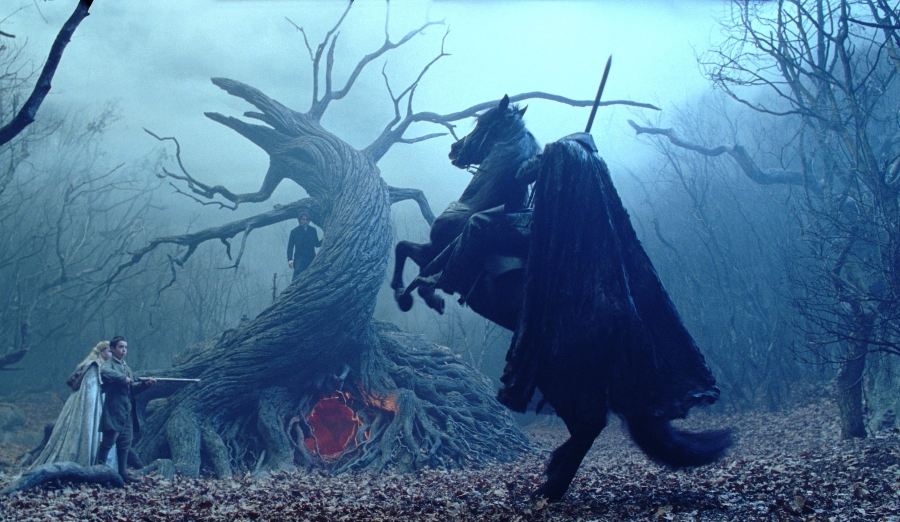
Tim Burton is probably one of the most iconic Gothic storytellers working in film today, and yet it has often been noted that he does not read much Gothic fiction. His stories (especially Sleepy Hollow and his recent Addams Family adaptation, Wednesday) play on tropes from Gothic literature. Yet Burton freely admits in interviews that he was more influenced by TV growing up than books. Commentators like Ian Nathan have highlighted how much classic monster movies rebroadcast on TV particularly influenced Burton, especially Edgar Allan Poe adaptations starring Vincent Price or the Hammer horror films starring Christoper Lee (often versus Peter Cushing). Hence, Burton plays on the Gothic tradition, but with a degree of separation.
Since Burton’s movies usually follow a Gothic monster plot (the village against a lone figure tormented for being different) but situate the monster as the protagonist (Edward Scissorhands, Frankenweenie, Batman), he is often read as offering a progressive inversion of Gothic tropes. The loner who seems to stand against traditional standards is the hero, showing the community’s morality is too restrictive.
While Burton would probably be the last person to call his movies “conservative,” his stories are at least on one level more traditional than appearances suggest. Burton often empathizes with monsters, but the monsters usually possess a strong moral compass that the community lacks, because the community’s claims to tradition are often flawed.
In the typical Burton film, the villains certainly see themselves as the bearers of tradition—proper ways of doing things, respectability. They may take pride in their history (the aristocratic parents in Corpse Bride, the Gotham City elites in Batman Returns) or their conservative-looking neighborhood (the mayor of New Holland in Frankenweenie, the housewives in Edward Scissorhands). But many times, the community that the villains take pride in is more artificial than they admit, their claims to morality not as accurate as they admit.
When Burton’s stories take place in “modern” neighborhoods, the community usually has a particularly 1950s suburban look, which places his critique of community in a particular context. As Nathan observes, these communities are inspired by Burton’s ambivalent feelings toward his childhood home: Burbank, California, home to multiple movie studios, but also “Anywhere USA” with a mid-century blandness that led Burton to call it “the pit of hell” in a 1998 Rolling Stone interview. Yet though Burton is critical of this 1950s conformist look, it would be inaccurate to say Burton dislikes everything about 1950s consumer culture. He loves the low-budget movies from that period, and especially in projects like Mars Attacks, he fills his stories with references and a certain sentimental optimism that feels very 1950s.
What Burton seems to dislike about the mid-century American suburban vision is its potential for hypocrisy. As he and frequent collaborator Caroline Thompson envision it, the worst suburbanites try to embody Americana, but their defining trait is how their culture looks organized, but not lived in. This is suburbia at its worst: so obviously new. So filled with people whose sense of history is limited and their wisdom shallow, but always claiming to be bastions of “old-fashioned American values.” The moment in Frankenweenie when the parents start squabbling at a PTA meeting about why Pluto isn’t a planet anymore sums up how short-sighted the community has become. Thompson offers a similar critique of shallow conformists her script for Edward Scissorhands, as well as in her earlier novel First Born (which she described as an adolescent critique of suburbia). Burton’s villains want to seem traditional but have no tradition to hold onto. No sense of history going back more than a generation, their values more about appearances than substance.
When Burton steps outside suburbia to explore urban or rural communities, he highlights a similar form of decadence that hides hypocrisy. These communities have access to history and tradition, but have lost their way. In Sleepy Hollow, Ichabod Crane learns the Headless Horseman is wreaking vengeance on respected local families for their hidden sins. In Batman Returns, the son of one old Gotham family (Bruce Wayne/Batman) fits two corrupt sons of old families (Oswald Cobblepot, Max Schreck). These are worlds in which people have become decadent and lost their way, becoming either dastardly or gullible. Not unlike the elites in The Fall of the House of Usher and many other Gothic films that Price starred in.
In contrast to the decadent communities, the isolated heroes in Burton’s movies may seem strange. However, his eccentric heroes but usually have the right values. They practice empathy for outsiders, truth over hypocrisy, humility over keeping up with the Joneses. Burton may be telling Gothic stories that situate the monster as misunderstood, but his monsters don’t have the dastardliness of Mr. Hyde. Even when they resort to violence (Edward Scissorhands killing a gun-wielding bully), they never embrace darknes as a vocation the way that Frankenstein’s monster does. If anything, his “monstrous” heroes are closer to Hester Prynne in The Scarlett Letter: ambiguous victims of circumstance but showing charity toward others that their upright neighbors never show.
For all his clever inversions and claims not to be literary, Burton understands the moral engine that drives the best Gothic films. His stories are usually morality plays, and they carry the same warning: treat others well watch out for hypocrisy. Those who pretend to know old-fashioned values but never garnered the wisdom to understand what those values mean will experience the consequences.
