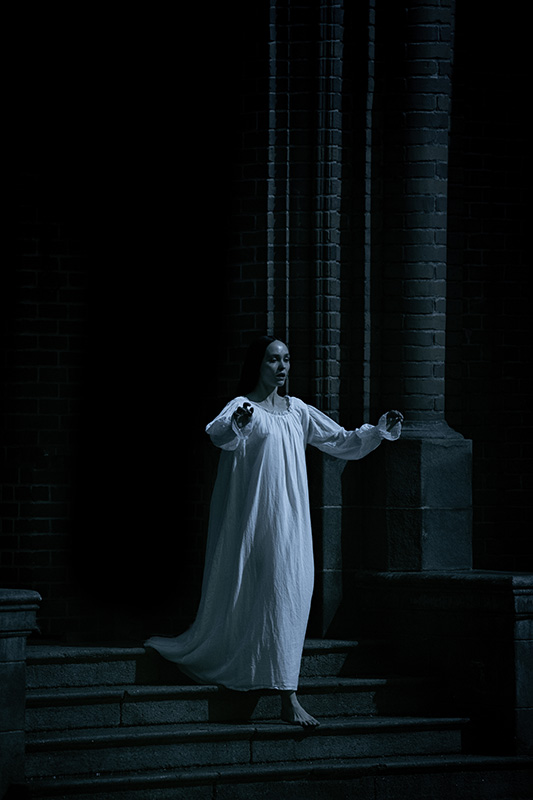
In recent press for his horror movie Nosferatu, Robert Eggers told an anecdote about a friend asking over text “What are you most afraid of?” Eggers answered loneliness or getting too deeply involved in the occult and losing his mind. The friend replied he was hoping for a children’s Halloween project idea.
The anecdote makes a good soundbite in any interview, and Eggers has shared it before when discussing The Northman. Still, it proves apt for understanding Nosferatu. More so than any recent filmmaker who has adapted or remixed F.W. Murnau’s 1922 German classic, Eggers communicates that this is a tale about the power of rituals, and how rituals have consequences.
The script follows the same basic outline as Murnau’s movie, itself an unauthorized Dracula adaptation. German realtor Thomas Huttar is sent by his employer, Herr Knock, to see Count Orlock in Transylvania and finalize selling Orlock a house. Thomas’s worried wife Ellen has premonitions of a coming evil. Thomas is overpowered by Orlock when he reaches the castle and when Orlock arrives in Thomas’ town, Ellen’s mood swings and nighttime behavior become dangerously bizarre. She slowly concludes a vampire is behind a spreading plague and some sacrifice must happen to stop the fiend.
However, Eggers avoids recreating most of Murnau’s visuals, filling his movie with new scenes. Knock is shown performing candlelit rituals and killing animals as “offerings” to Orlock. Ellen, who has apparently been sensitive to the paranormal from birth, is depicted as suffering from demonic possession (with several allusions to The Exorcist). After escaping Orlock’s castle, her husband gets healed (in what looks much like an exorcism) by Eastern Orthodox priests. When Orlock arrives, it becomes clear that Ellen accidentally invited Orlock to control her as a child, and he wants her to fulfill her end of the “covenant.” He even shows a document that Thomas thought was a realtor contract with odd language but was actually a contract signing away his wife to Orlock.
Some of this language about ritual and possession is implicit in Murnau, but not only to a point. The 1922 film changes many things from Stoker’s novel (British characters become German, etc.), allegedly to hide copyright infringement. Less discussed is how much the changes alter the religious framework. In the novel, vampire hunter Abraham Van Helsing routinely calls Dracula a demon and sees killing vampires as a Christian duty to stop evil. Many Dracula adaptations (especially the Hammer series) depict Van Helsing as slightly outside the religious establishment but on the right track, an unconventional priest-exorcist. In Murnau’s film, a Van Helsing character appears briefly to explain vampirism but never fights the vampire. The combating evil falls to Ellen, whose “hysteria” seems to be suppressed psychic powers. Hints about demons and possession appear (Orlock is called a creation of the demon Belial and Knock acts like an unhinged demoniac). But without a clearly holy character, the moral lines between holiness and blasphemy feel fuzzy.
That ambiguity is intentional, fitting the filmmakers’ spiritual views. As Katharina Loew discusses in her book Special Effects and German Silent Film, producer Albin Grau, Murnau, and others were interested in alternative spiritual movements, especially theosophy. She notes how this affects the film in several ways, including making Ellen psychic and the vampires ugly (in Gnostic terms, vampires are bestial rebels resisting the call to become pure spirits). Instead of depicting a spiritual conflict between light and darkness, the film seems more interested in things we now associate with New Age spirituality (astral projection, matter vs. spirit, and everything depicted in various moral shades of grey).
The ambiguity may also explain why remakes and homages to Nosferatu rarely offer a full-blooded depiction of Christianity. Werner Herzog’s 1979 Nosferatu the Vampyre offers a Van Helsing who finishes off the vampire, but the character feels tacked on and his mission fails: the movie ends with a man infected by the vampire riding into the distance. David Lee Fisher’s 2023 remake with greenscreen footage from the 1922 film avoids spiritual discussions, instead having characters discuss the nature of love (Ellen sacrificing herself is love personified).
Eggers offers an ambiguous Van Helsing figure: Professor Albin Eberhart Von Franz, a Swiss academic disgraced for his interest in alchemy. Scholars will point out that alchemy is closer to Christian mysticism than witchcraft, and Von Franz is closer to the angels than the demons. But he is not exactly orthodox. At one point he tells Ellen, “I am but an able tourist in this occult world. You were born to it.” His job is framed less as defeating evil as God’s representative, more as helping Ellen understand the games that Orlock plays with her.
Eggers may not recapture the full-blooded image of pious warriors fighting demonic entities in Stoker’s Dracula. In a post-Christian Western context, when biblical allusions sound cryptic and symbols like crosses or priestly robes command little respect, it’s difficult to cinematically achieve that vision. However, Eggers’ emphasis on ritual makes his take on Nosferatu more religious than many recent vampire movies. Holiness may not get a great depiction but the supernatural is framed as something that should be treated seriously. Deals with dark spiritual forces are treated not as toying with possibilities but as covenants, a word meaning a binding contract with long-lasting effects. Rituals (to summon demons, to seek God’s help) are handled not as performance art but as liturgies showing what (or whom) we follow.
Instead of vague spiritual exploration in which everything is spooky but nothing is really dangerous, Eggers alludes to an earlier worldview. A worldview that warns what we pursue becomes what we worship. What we worship defines us far more than we realize.
